Showing posts with label theology. Show all posts

Friday, May 16, 2008

Thoughts on the Trinity

by Nancy Jago Finley


My Irish aunties were wonderfully superstitious. They knew that good things (and bad) come in sets of three. They were first generation Americans and kept to the “old ways” from Ireland which I now see as a delightful mix of Roman Catholicism, Celtic mysticism, and folk wisdom. I suppose I can attribute my appreciation for Trinitarian theology to them. It forms the foundation of my belief in God and without it I don’t think my faith would stand up very well. The more I learn about the Trinity, the more my appreciation of it deepens and broadens so that now it is informing my understanding of what it means to be human.


God, the Father as ALEPH
The first word of the Torah – BERE’SHIT – starts with the second letter of the Hebrew alphabet. As I understand it, this is intentional as the first letter – ALEPH – represents the uncreated Creator, the eternal One whose energy is timeless and beyond measure. ALEPH is the silent letter that symbolizes the silence of Spirit from which all sound flows. In ALEPH lies the potential for all that has been, is, and will be.


God, the Son as BET
The name of the Hebrew letter BET means house. BET ALEPH means home for the Spirit. Creation is where we, as part of creation, are home for the Spirit. My interpretation of Bet Aleph points to the embodiment of the Divine in all that is. Matter matters. As Christians, we look to the model of Jesus to help us understand God’s presence in the human experience. The embodied world becomes the medium through which we search for and hopefully experience God.

God, the Holy Spirit
Without energy, the creator and the created are dull, dead, frozen. The Holy Spirit represented by the Chinese letter for “chi” at left symbolizes the energizing force that surges through all of creation binding it with the creator and with itself. We are alive and in communion with each other and with the creator because of Spirit. As Christians, we regard Love as the force that unites, allowing us to realize that everything is connected with everything else. Being is also dependent on movement and change.


So, the Trinitarian model reveals God as uncontainable but at the same time the container, the contained, and that which enlivens and is the source of the unifying power of Love. God is Father, Son, and Holy Spirit.


IMAGO DEI
The Creation story in Genesis tells us that humans were made in God’s image. So, if God has three aspects, then so do we. We have the capacity to recognize that we contain and are contained by the ultimate mystery of God “the Father.” We also are able to allow our sense organs to become God detectors by our interactions with other elements of creation. And we have the capacity for enormous love of God, each other, and all of Creation. I believe that our goal as humans is to allow these three Holy aspects of ourselves to be experienced in balance.

LOSING OUR FOOTING ON THE GROUND OF BEING
Many of us tend to ignore the 1st “person” of the Trinity, God “the Father.” To the degree that our attention is absorbed by the material world, our awe of the Holy Mystery is diminished. As our awe diminishes, we can become inflated with pride at our God-like qualities. When our egos become so inflated with the idea that we are God-like, then we may begin to believe that we are Gods! We might believe we’re in control and that we don’t need to humble ourselves to any power greater than ourselves.


Further, when we act on the belief that we humans are like Gods but that the rest of Creation is not, then we set ourselves up for participating in many ecological evils. Abuse of animals and other growing things, water, sky, and land are consequences of anthropocentrism. Add to our excessive pride the cultural ideal of individualism at the expense of collectivism, the scale becomes even more unbalanced. We lose sight of our place in nature.

THE ANSWER IS BLOWING IN THE WIND

Ego inflation is one danger of an overblown 2nd “person.” Ego alienation is another. Both are consequences of imbalance. If we become alienated from the Divine within us and from one another, the 3rd “person” of the Trinity is stifled. The Holy wind dies down to stillness. The “third person” of the Trinity can also become obscured when we refuse to die and be reborn. The Holy Spirit is fluidity itself, the antithesis of stagnation. If we stubbornly hang on to a rigid idea of the Holy and of Truth, including truth about ourselves, we knock the wind right out of us! And when the movement of Spirit is inhibited, habits of the heart, mind, and body take root and our suffocation is usually so slow and insidious that we aren’t even aware of how stuck we’ve become. The nature of Spirit is to move in freedom.


THE FORCE IS WITH US
This snapshot of my current understanding of God and Humankind suggests that we are vulnerable to ego inflation as well as ego alienation when our Trinitarian nature is out of balance. If we think we’ve got God figured out and become so fascinated by our own powers of knowing, we become inflated and the grace that flows out of humility is diminished. On the other hand, if we become alienated from God and/or our God-Selves, we may become dispirited and feel like we’re all alone in a stagnant pond. It’s our freedom exercised in humility that allows us to receive God’s self communication in Truth and Love. The three aspects of God within each of us are in dynamic and life giving tension. This tension provides the energy to fuel our ongoing journey to know Truth and Love in our relationships with God and with others while gracefully adapting to change. Even though we might be unbalanced, God is not. God is like a gravitational force that attempts to pull us back into balance and closer to God. Seeking, receiving, and maintaining that balance is our ultimate spiritual challenge, both individually and collectively.


Nancy Finley is a long time member of St. Paul’s and is currently a graduate student at Seattle University’s School of Theology and Ministry studying to be a spiritual director. She also is on the faculty at North Seattle Community College and teaches lifespan developmental psychology online. Her course website is: here.

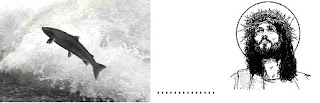
Friday, March 21, 2008

Christ in Salmon, Salmon in Christ

By Nancy Jago Finley


I rode into Christianity riding on the back of a salmon. It was the salmon’s life cycle that gave me a window into the Jesus story. It opened the door to the church. Here’s how it happened:

Many years ago I visited the fish ladder at the Ballard Locks here in Seattle to watch the salmon returning from the sea to their spawning grounds. They were eagerly going home to die for the sake of future generations. As I watched them struggling against the current, swimming upstream with great effort, I cried at the beauty of it. I learned that their dissolving corpses served as nourishment for the new life they had created just before they died. I made no connection to Jesus at the time as I was defiantly unchurched. Christianity wasn’t even on my radar.

About 10 years ago I cautiously approached the idea of institutional Christianity and took the sacramental bread and wine for the first time in maybe 30 years. I heard the stories about Jesus’ crucifixion and resurrection and remembered the salmon. Soon I came to understand those stories as representing the same process revealed in the salmon life cycle. Jesus sacrificed his life as all living things do so that others may live. But, by dying, we become immortal. It’s part of the nature of things. Dead flowers and leaves become humus out of which new life emerges. We eat Jesus’ body and drink his blood to symbolically nourish us as we journey through our lives toward union with God.

Concerned that my equating Jesus with salmon might be considered irreverent or even heretical, I did not speak of this until attending a retreat on Celtic Christianity where I learned that the salmon is a symbol for Jesus among the Celts. I now proclaim that as embodied beings, Nature is where we encounter God.


Nancy Finley is a long time member of St. Paul’s and is currently a graduate student at Seattle University’s School of Theology and Ministry studying to be a spiritual director. She also is on the faculty at North Seattle Community College and teaches lifespan developmental psychology online. Her course website is: here.

Thursday, March 6, 2008

Humility

by Martha Wakenshaw

I've been thinking a lot lately about Christianity and Psychology, especially in this season of Lent.
The prayer book talks about penitence and even our own "wretchedness." It talks about confessing our sins and keeping a contrite heart. We fall to our knees in supplication. We ask God's forgiveness. We stand corrected.
So how does this season of penitence fit in with our own self-esteem? How do we bow down and confess our sins before God and still maintain a healthy sense of self-esteem?
I believe that God has given us humility as a way around this conundrum. Humility in the sense of softening our hearts to allow the light and compassion of Jesus in. With the spirit of God internalized we come from a place of strong vulnerability and are able to confess our sins in the all loving arms of Jesus, the great forgiver.

Martha Wakenshaw is a member of St. Paul's, a writer, and a psychotherapist. Her website can be found here.

Monday, December 17, 2007

Lost and Found

By Martha Wakenshaw

Lost and Found

I lost my faith, but I'll have to check my back pocket
because I may have stuffed it there absentmindedly and
when no one was looking.

I may have put my faith in a file drawer
to be pulled out later or in the dog's bowl
by accident or the old leather messenger bag
hanging on the wall.

I feel faith trying to find me, tugging
at my sleeve like a small child.

I hear faith crying out in the wilderness in
that wild and wonderful place of unknowing.

I see faith shy and hiding in the shadows
afraid to look up.

I smell faith in the incense thrown all around
like a foggy autumn morning.

I can almost touch faith, brush my cheek
against it's warm body.

Faith plays hide and seek with me
now seeking me, now calling out
"you're it."

Martha Wakenshaw is a member of St. Paul's, a writer, and a psychotherapist. Her website can be found here.