Showing posts with label reflection. Show all posts

Saturday, November 15, 2008

My Burning Question

by Lynn Adams

Whenever we come to the parable of the ten bridesmaids, perhaps better known as the wise and foolish virgins in Matthew 25:1-13, I get all weirded out over how self-righteous and just plain mean the wise bridesmaids are toward the foolish bridesmaids. You probably remember other parables where some hapless person gets thrown into the outer darkness by the God figure, which is always unsettling.

In this case, the bridegroom is in sight, so surely the girls can share the oil on hand among all the lamps. Go to the merchants? How disingenuous! It's midnight, for gosh sakes. And then the bridegroom praises the prigs and makes the featherheads miss the wedding. If this bridegroom is God's spokesman in the story, then I don't get it. I thought we were supposed to do everything in love, be generous and kind-hearted. Why would God commend causing someone else embarrassment?

As you may recall, last Sunday, Melissa preached on this parable. (Please read her sermon of November 9th -- to which I am responding.)

Melissa started out her homily by recounting how several clergy were comparing notes for the task of preaching on this reading. She said their ideas began to home in on one question… At last! I thought. This will give me my answer. But it was some other question. At the end I almost raised my hand. This is interesting because the parish is now planning a new Sunday evening service where the congregation will be encouraged to respond to homilies! I'll be there.

Down at coffee hour I mentioned my burning question to several wise people. Why would (God) the bridegroom welcome self-righteous people and banish goof-ups?

Mark gave me a meaty and satisfying response, and I hope this is faithful to the original: Matthew was writing in a time of great uncertainty in a deeply divided Jewish community after Jesus' death. Matthew often frames the ideas of Jesus in parables that emphasize the importance of vigilance, attention, and being ready, since the opposite traits may permit the newborn worldview to be reabsorbed into religion as usual. Mark cited Melissa's insight -- it's about waking up and being ready.

Reminding me not to be so literal, Richard offered a koan-like answer: Because it's a story.

Bob, experienced in the ways of families, said: They were probably sisters.

Melissa said: I don't know, but isn't that just like a bunch of teenage girls on a sleep-over?

At the end of a delightful coffee hour, I had the cozy feeling of sharing Thoughts About Important Things with a bunch of my friends. If anyone else has ideas about (1) staying awake and being ready, or (2) My Burning Question, please write in!

Lynn Adams is a longtime member of St.Paul's.


Monday, October 6, 2008

Blogging Lectio Divina

by John Forman


Lectio divina on Matthew 11: 25—30

[Lectio divina, an ancient art once practiced by nearly all Christians who could read, is a technique of a slow, contemplative reading primarily of scripture that enables a deeper union with God. The practice is one of the precious treasures and defining characteristics of Benedictine monastics, together with the daily liturgy and manual labor. The technique has four basic steps. In the first step, lectio, we read slowly, attentively, gently listening to hear a word or phrase that is God's word for us this day. Once a word or a passage speaks to us in a personal way, we "ruminate" on it. Consider the example of Mary in Luke’s Gospel "pondering in her heart" what she saw and heard of Christ. In the second step, meditatio, we take in the word and allow it to interact with us. The third step, oratio, is prayer understood both as dialogue with God and as the offering of ourselves to God. Here we allow that which has touched our hearts and upon which we have pondered to merge with our deepest selves. The last step is contemplatio in which we simply rest in the presence of God. In this wordless, quiet rest we return to the silence that began our session.]


[Lectio] “I thank you, Father…because you have hidden these things from the wise and the intelligent, and have revealed them to infants…”

[Meditatio] This passage seemed especially appropriate as I anticipated taking my daughters to St Paul's to help out with the people gathering to learn about Godly Play. Not just because it talks about children, but because I think it describes an essential approach to learning for all of us.

Jesus makes a distinction that is very similar to one made by researchers in adult development between a “knower’s” mind and a “beginner’s” mind. Adults become intelligent “knowers” over time as we learn about and become good at business or nursing or teaching or raising children. Being a “knower” is not a bad thing by itself. It’s just that when we are so certain of what we know, new patterns or approaches become hidden from us…we overlook them. That tendency is why magic tricks work for adults, but is usually lost on children. Sleight of hand relies on the audience “knowing” that a silk scarf can’t disappear or a coin can’t pass through a sheet of rubber. Adults are astonished when a magician does exactly what we “know” can’t happen…little children are less than impressed with the “magic” because they simply trust that the magician can do what they say they can do.

Part of the intent of Godly Play is to work with children’s natural tendencies toward their God-given openness to possibility. I also don’t want to romanticize the mind of an infant…these are people who are still learning how to walk and use a toilet after all. So it’s not their “smarts” that Jesus is referring to….it has more to do with trusting, curious openness …the “beginner’s mind” that we all have. When adults look at the world with “beginner’s mind,” we can assume that what we know is only part of the story and that allows us, as the founder of Godly Play, Fr Jerome Berryman says, “to move forward imperfectly into the unknown,” which includes seeing setbacks as just part of the creative process.

There’s a story about a village in India where people were living in poverty. They did have two things in abundance: a large number of women who could carry heavy loads and a lot of unused land. Taking on a beginner’s mind, they decided to combine the two. The women dug a huge catch basin and used the dirt to build a dam around it. When the monsoons came, the dam caught the rains and filled the catch basin, which kept the village’s wells from going dry. They had enough left over to sell to irrigation water to farmers outside the village.

I think Christ is inviting all of us to, first, adapt a similar “beginners mind” that is less focused on what we know or lack and one that is more open to possibility…to exchange our heavy burdens for light…maybe even the light of illumination or the insights that are hidden until we ask: “what if?”

[Oratio]

“What if you slept,
And what if, In your sleep,
You dreamed?
In your dream,
You went to heaven
And there plucked
A strange and beautiful flower?
And what if,
When you awoke,
You had the flower in your hand?”

Samuel Coleridge


[Contemplatio]

John Forman is a member of St Paul’s who serves at the altar, leads St. Paul’s intercessory prayer team and is a Eucharistic Visitor. Outside of St. Paul's he is a Benedictine oblate of Mt Angel Abbey and an organizational development consultant and executive counselor. John is the managing partner of Integral Development Associates.

Tuesday, September 16, 2008

September 11, 2008

by Lynn Adams

On September 11, 2008, I am in New York City (Brooklyn, technically), occupying Grumpy's Coffee House, corner of Meserole and Diamond. I have been hearing, then listening, for at least 20 minutes to a recording: two chords whose outer voices never change, a synthesized reverberating organ tone, slowly undulating back and forth. Feeling myself wrought up with pathos, poignancy, and a pressure presaging poetic utterance -- I wonder if this great OhhhhhMmmmmm of a track evoked my heart-state, or Nine-Eleven did, or Philip Yancey.

I am reading Yancey's "Soul Survivor," (Doubleday, 2001), a collection of essays on religious thinkers who helped Yancey salvage his faith from a bad religious childhood. The opening essay on Martin Luther King Jr. and Yancey's moral awakening kept me near tears. Now I am reading about how G. K. Chesterton helped him begin to retrieve the generosity and love of God.

My thoughts shift to the tragedy seven years ago and the worldwide tragedies that followed. I remember my fear when TV showed fireballs melting two skyscrapers. My daughter, who had just arrived at college in lower Manhattan, was witnessing the shattering event up close. How far was the World Trade Center from NYU? On my map the dots were less than an inch apart.

I write a paragraph on the maturing that has continued in my daughter since that time. I turn my head sideways to squint at it, and conclude I'm a mom in rose-tinted glasses. Oh, well. Parents, aunts and uncles, I ask you, can anything beat the thrill of seeing your child emerge as a reasonably healthy young adult?

Two pages back, I opened my journal to copy in a quotation I liked, and went happily off on the tangent you have just read. I'll be delighted if there is some tie-back between the quote and what I have just written.

Yancey, Soul Survivor, p. 46
Albert Einstein once articulated the most important question of all: "Is the universe a friendly place?" ...
p. 49
Loren Eiseley tells of an event he calls the most significant learning experience of his long life. Caught on a beach in a sudden rainstorm, he sought shelter under a huge piece of driftwood where he found a tiny fox kitten, maybe ten weeks old, which as yet had no fear of humans. Within a few minutes it had engaged Eiseley in a playful game of tug-of-war, with Eiseley holding one end of a chicken bone in his mouth and the baby fox pulling on the other end. The lesson he learned, said Eiseley, is that at the core of the universe, the face of God wears a smile.

Sages say we are made in GOD's image and that could either be very good or very bad news. On an anniversary of hatred and calculated violence, in a moment aware of mother love, I ask myself Einstein's question.

I'm going to try this assertion and see if it works. The heart-states of pathos, poignancy, eloquence of experience, being maternal, and being playful: these are some of the signs in the human image of God that, in spite of everything, on the whole, point to an answer. Yes. The universe is a friendly place.

Lynn Adams is a longtime member of St. Paul's.

**editor's note** We are about to begin our fall Foundations Course at St. Paul's, and the topic is Picturing God: Exploring Images of the Holy One. Keep an eye here for more reflections on the various images of God we discover through our conversations together, and if you are connected to St. Paul's and have something to contribute to the blog in this theme, feel free to send it to me for consideration by clicking here. -Alissa.

Tuesday, June 10, 2008

Prologues

by Robin Allan Jones


I love prologues. “Two houses, both alike in dignity, in fair Verona, where we lay our scene . . .” “Now is the winter of our discontent made glorious summer by this son of York . . .” I love prologues so much that I wrote one for myself. In our recent production of St. Paul’s Episcopal Church’s Umbrella Theatre Company, Noah Way Out, the play begins with a prologue that tells of the nearness of heaven to the medieval imagination. And so, I enjoyed the exquisite pleasure of uttering the opening lines, savoring that surge of adrenaline that ignites the story: “The medieval era, the centuries in the wake of the fall of the Roman Empire . . .” It does seem awfully full of brass and tympany for what was purported to be a “screwball comedy,” but were it humanly possible, I’d make a career of reciting prologues. Because for a moment, I was cast a quarter of a century back into my youth as a college theatre student, reliving the ineluctable joy as the lights would fade up, the opening lines were declaimed, and the fluttering off-stage visceral nervousness would be pushed aside as I anticipated my first entrance.

Equally, I suppose, I love the beginnings of novels: “Call me Ishmael . . .” “It was the best of times and the worst of times . . .” The beginnings of novels and plays are like those magic words on old maps: Terra Incognita “Land Unknown.” “What country, friends, is this?”

Beginnings are always loaded with potential, with promise; beginnings are always the undiscovered country; beginnings always have implied ellipses trailing them because we keep close to our hearts the promises of the imagined what-could-be.

What’s not so hot are the words “The End.”

In the period that we rehearsed and launched Noah Way Out I, as one of St. Paul’s liturgical ministers, shared the honor and joy of serving at the baptism of possibly one of the most beautiful children I have ever seen. This child took to the baptismal water like a baby dolphin. One suspects a mermaid in the pedigree, and this baptism had all the thrill of “Once upon a time . . .” But in that same rehearsal course of time I also served as a liturgical minister, this time at the Cathedral, for the funeral of a friend. This was a thudding, sad, emptiness-leaving, too-soon “The End” for a woman loved by just about everyone who ever knew her, leaving a story of unfulfilled potential without a denouement. I am certain my own sorrow over this still bleeds along the courses of the cracks in the concrete floor of St. Mark’s.

Endings are like that. Rare is the movie that ends as well as it begins; common the novelist who will tell you that the book on which he tapped out “The End” was not the book he intended to write, and there is always a part of us that wishes Romeo and Juliet could live for eternity happily ever after.

But life in the Church is about funerals, not just baptisms, and it’s about everything in between. It is as much about “death do us part” as it is the delectable seduction that leads to “I do.” While I may find that endings make me ache with hollowness, the fact is, we as Episcopalians celebrate every minute of the human experience. We ceremonialize all the landmarks as we recapitulate the terrifying steps to the Cross, and by this celebration, this reliving of the ages of humankind, we honor those landmarks, and we warrior-like look our endings in the eye.

My bedraggled cast and crew, beset by weather, desertion, and delay, eventually brought Noah to his rainbow ending—it would seem our Episcopalian God is not content to have us simply ride the flood; He insists we row and hoist a tattered sail. But as Carlos Castaneda has Don Juan Matus point out: “The warrior laughs and laughs.”

Robin Allan Jones wrote and directed the Umbrella Theatre Company’s Noah Way Out

Monday, March 24, 2008

Rebirth

by Auntmama
Mary Anne Moorman


Mama and I were diametrically opposed on most things Easter. Spring tumbled over itself in fields of warm sun made for play but mama had clothes to sew, decorations to make, new recipes to conquer. I had balls to throw, baby rabbits to watch, new clover to string into halos. I was everything outside. Mama was everything in. But we met in the middle when it came to the egg and found forgiveness over a rabbit.

Nothing says new life like an egg. Mama drilled us on redemption during Lent but when Palm Sunday came it was all about life. Right after we stored the palms from the annual pageant we raced home to begin egg production. All week Daddy brought home dozens and dozens of eggs from the railroad commissary.

Mama sorted them for baking, boiling and blowing. We spent the rest of Palm Sunday, blowing. Mama took her favorite long sewing needle and poked a tiny hole in each end of the egg. Then just like she was blowing bubbles, she’d squich up her lips and begin to blow.

She’d puff the tiniest little pillows of air into the hole and hope the contents would slip out the other end. This was tricky and it sometimes took a few eggs to get it right. Daddy’s job was to cheer her on when an egg cracked and all the goo ran over her finger like melted butter.

“Its okay honey, they’re perfect for scrambling,” he’d say and pick shells out of Monday’s breakfast. My brothers tied circles of green ribbon to hang the finished egg and mixed the paints.
We used all kinds of coloring on account of brother Shack’s artistic pursuits. Whatever he was painting with wound up on these eggs. This was mama art.

The colors had to be festive and bright , for mama’s egg tree. We could use anything we wanted on our boiled eggs. Those were for the egg rolling contest and the Easter egg hunt. They’d be broken in minutes. But the tree was different.

The tree was like mama’s own thank you to Jesus. Mama blew until she had about two dozen clean white, empty shells all laid out like a canvas. Then she’d dip her dime store brush into water colors, or food dye or even oils if Shack had any, and paint the most marvelous eggs.

By suppertime the kitchen table was a gallery of spring. There were crosses and lilies, faces of the main characters, and baby lambs grazing on new grass. Eggs had to dry overnight but when we came down for scrambled breakfast, the beautiful eggs dangled from their green ribbons on a stick tree.

The exquisite hand painted eggs guarded our front door and welcomed us home as the tension mounted during Easter week. Mama baked every day and sewed. She was determined her children would each wear something new for Easter Sunday even if it meant she had to stay up till dawn sewing a blouse or a new shirt or dress. One Easter she made me a yellow and gray striped suit.
The stripes were hard to match and I had to stand still forever for fittings.. Mama raced the clock on Saturday to finish my skirt hem.

“Mama, it is straight enough,” I’d whine. Mama pinned and tucked while I fidgeted in front of the egg tree.

”Which is your favorite egg,” she asked to distract me. This had gone on for a week and I was tired of egg stories.

“Mama the boys don’t have to come inside and get pinned up,” I complained until she’d finally beg me to hold still before she turned me into the pin cushion.”


I could not stand still. I did not want to stand still and I did not understand why my Lord and Savior needed me wearing new clothes on Easter. Mama said it was the least I could do and told me about Judas as she knelt to re-pin the hem.. I knew she was exhausted. I knew she was just trying to do something for me but I was down to my last raw nerve.

I was about to explode when daddy opened the front door with A newborn brown bunny tucked in his jacket.

“Oh Daddy , daddy daddy let me see” I whirled around to pet this adorable creature and when I did, I smashed right into mama’s egg tree. Painted egg shells flew in all directions. A little lamb face crumbled on the floor.
Palm leaves mounted in crushed bits. Mama burst into tears as Virgin Mary shattered before us. Daddy mumbled unmentionables in my directions. The bunny ducked in fear.

I figured this disaster might prevent Peter Rabbit from leaving chocolates and got to sweeping right away. It was the least I could do for mama. Daddy tried to comfort mama and I scooted out to find the broom at lightening speed. Brothers opened the door to find me crying and sweeping and were so astounded they couldn’t even tease me. This was terrible. No one had ever broken the egg tree not even Ken with his eternal yoyo. They boys almost looked sympathetic as they made peanut butter sandwiches. Mama and Daddy and the rabbit disappeared. This was highly unusual as our parent hung over us most of the time.

As I was falling asleep and wondering if the Easter bunny would cancel his annual appearance, Mama slipped into my room. She had the new bunny in her arms and put him on the pillow. I was about to wail all my sorries to her but mama just gave me a huge hug and crawled in next to me and the bunny.

“It’s almost Easter,” she said “and forever more, we all get a new chance by light of day.”

Mary Anne Moorman is a regular attender of St. Paul's.

Friday, March 21, 2008

Christ in Salmon, Salmon in Christ

By Nancy Jago Finley


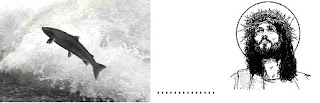
I rode into Christianity riding on the back of a salmon. It was the salmon’s life cycle that gave me a window into the Jesus story. It opened the door to the church. Here’s how it happened:

Many years ago I visited the fish ladder at the Ballard Locks here in Seattle to watch the salmon returning from the sea to their spawning grounds. They were eagerly going home to die for the sake of future generations. As I watched them struggling against the current, swimming upstream with great effort, I cried at the beauty of it. I learned that their dissolving corpses served as nourishment for the new life they had created just before they died. I made no connection to Jesus at the time as I was defiantly unchurched. Christianity wasn’t even on my radar.

About 10 years ago I cautiously approached the idea of institutional Christianity and took the sacramental bread and wine for the first time in maybe 30 years. I heard the stories about Jesus’ crucifixion and resurrection and remembered the salmon. Soon I came to understand those stories as representing the same process revealed in the salmon life cycle. Jesus sacrificed his life as all living things do so that others may live. But, by dying, we become immortal. It’s part of the nature of things. Dead flowers and leaves become humus out of which new life emerges. We eat Jesus’ body and drink his blood to symbolically nourish us as we journey through our lives toward union with God.

Concerned that my equating Jesus with salmon might be considered irreverent or even heretical, I did not speak of this until attending a retreat on Celtic Christianity where I learned that the salmon is a symbol for Jesus among the Celts. I now proclaim that as embodied beings, Nature is where we encounter God.


Nancy Finley is a long time member of St. Paul’s and is currently a graduate student at Seattle University’s School of Theology and Ministry studying to be a spiritual director. She also is on the faculty at North Seattle Community College and teaches lifespan developmental psychology online. Her course website is: here.

Thursday, March 20, 2008

Feet

By Alissa Newton

Today is Maundy Thursday , the beginning of the end of Lent and the beginning of the Triduum, the time when we remember and liturgically re-live the three days before the death of Christ.

I've always loved Maundy Thursday, even before I knew that some people used that name for it. Growing up in an evangelical non-liturgical tradition the Thursday before Easter was simply "The Foot-washing Service." There is something undeniably intimate and vulnerable about the washing of feet, and as a child I found this both moving and sort of thrilling. In the church of my childhood this was a segregated service, women in one room and men in the other. I don't know what happened for the men, but in the women's group we would all sit in a circle and sing hymns. Every year sometime before the foot-washing service my Mom would tell me a story about one of the first times she attended, when she was a young woman. She might have even been a teenager. After the singing of hymns began, each woman would wash the feet of the woman sitting next to her, and so on in a circle until everyone had both washed and been washed. My mother, the young woman, happened to be sitting next to one of the matriarchs of the church, an elderly lady whose movements were slow and hands shook. Mom was slightly horrified to realize that this woman would be washing her feet. I remember listening to my mother tell of how she sat and had her feet washed by someone so much older than her, wiser, and much more frail, and how that moment both humbled and exalted her. Sometimes when she told the story her eyes would brim with tears, remembering. I loved to hear it, and I loved to be a part of the whole ritual. The church I grew up in had little in the way of formal ritual, but what we had I reveled in. At the Foot-washing I felt connected to the Church, even as a child, in a way that was unique to my experiences in church at the time.

Now I still love the footwashing ritual. Set within an Anglo-Catholic mass, with choir and Eucharist, robes and incense, men and women together - the washing of another human being's feet remains one of the most intimate and powerful experiences of community that I have ever been exposed to. It is an act of service that is equally humbling for both recipient and the one who washes. Feet are so often a neglected body part - they do so much of the work of getting us around, but in our culture are seen as dirty and sort of private. It's rare to have someone else touch them. And even more so in the context of the Sacred. We Anglo-Catholics are so in love with Beauty and Mystery, two qualities rarely discovered in feet.

I hope today can be a reminder to me that in the context of Eucharist, in the Kingdom of God, the neglected and dirty can be part of what is Holy and Beloved and Beautiful. Jesus' feet were washed by the tears of a shamed woman who brought him perfume. Jesus washed his disciples feet before he gave them the first Eucharist. Humility and vulnerability are powerful and important, these stories tell us, and Christ proves to us as he embodies both in order to bring us through Maundy Thursday and tomorrow's Good Friday, to Easter.

Alissa Newton is Jr. Warden at St. Paul's and the editor of the parish blog. This entry is cross-posted to her personal blog, which can be found here.

Thursday, March 6, 2008

Humility

by Martha Wakenshaw

I've been thinking a lot lately about Christianity and Psychology, especially in this season of Lent.
The prayer book talks about penitence and even our own "wretchedness." It talks about confessing our sins and keeping a contrite heart. We fall to our knees in supplication. We ask God's forgiveness. We stand corrected.
So how does this season of penitence fit in with our own self-esteem? How do we bow down and confess our sins before God and still maintain a healthy sense of self-esteem?
I believe that God has given us humility as a way around this conundrum. Humility in the sense of softening our hearts to allow the light and compassion of Jesus in. With the spirit of God internalized we come from a place of strong vulnerability and are able to confess our sins in the all loving arms of Jesus, the great forgiver.

Martha Wakenshaw is a member of St. Paul's, a writer, and a psychotherapist. Her website can be found here.

Tuesday, February 12, 2008

On the eve of Lent..

by John Forman

I sat down to write this on Mardi Gras. Well, having spent the evening with my daughters watching an old Star Trek, I can’t really call it a “Fat” Tuesday…more of a chubby Tuesday or maybe a Tuesday who occasionally uses food as an emotional crutch…much like the excess of boyish enthusiasm spilling over my beltline these days.

I guess it came closer to a “carnival”, from the Latin “carne evil,” meaning “the meat’s gone off, so let’s not eat it for a month.” We now, of course, more generously translate the phrase to mean “goodbye to flesh,” in recognition of the traditional practices of dieting (although this Lent is so soon in the year that I haven’t even had time to finish procrastinating on my New Year’s resolution) or the omission of meat from one’s diet.

Now because we live in a largely Asian neighborhood, we’ve incorporated local customs into our own. So, for example, in recognition of the concurrent Chinese New Year – the Year of the Rat – we have sharply curtailed the consumption of all rodents for the entire Lenten season…a practice I have high hopes will stick with us substantially longer.

I grew up, like many people who survived childhood, thinking that Lent was primarily about giving up those things which brought you the greatest joy…chocolate, gin, jazz and hanging around with people of questionable moral fiber, such as clergy. Until, that is, I met a priest who shall remain nameless – although his initials are “Charles Ridge” – who taught me an entirely new way of thinking about Lent.

As we sat merrily doing our rosary with hot coals strung on barbed wire and trading fleas for our hair shirts, Charles also managed to introduce to me the deeper meaning and opportunity of Lent. In all seriousness, it has become a time of increasingly profound joy for me. What Chuck taught me over the course of several years was that it isn’t the things, events or people themselves so much as it’s the reshaping of our relationship to them that we undertake in Lent.

It’s a lightening of the load as we run toward God…a readjustment of our response to the first great commandment. Have we put God first among all our relationships? Do we love God with all our strength, all our minds, all our hearts and all our souls or are there one or two things that have slipped up the priority list for our time, attention and energy?

I was doing some reflection last week on our recent Foundations course on Forgiveness and preparing for Lent (as a Benedictine oblate, I am required to submit my intended Lenten practices to my Abbot each year for his approval). I found one or two encumbrances…situations with two people that I had not yet fully reconciled so that they could take their proper place as lesser than my relationship to God. To that end, I found and adopted a prayer, which I’ll be praying daily on their behalf (and for my own softening and growth) as a part of my Lenten practices. I’ve already sent it to Chalice, our prayer team, but I’ll share it here with you in the hopes that it may be useful to you as well:

“May you be happy
May you be free.
May you be loving.
May you be loved.
May God bring you to the fullest completion that God’s love calls you.
May every fiber of your being resonate to the glory to which God calls you.
May you experience the fullness of peace in body and soul.
May you know God in all God’s goodness.
May you forgive every transgression.
May I forgive you with all my heart and soul.
May you know what it means to be a child of God.
May you experience the glory of possessing the kingdom of God.
May you walk in peace and fellowship with all God’s creatures.
May every blessing be yours.
May goodness and love show themselves in everything that you do and in all that is done to you.

May you be one with all of God’s creation.
May you experience the blessings of God’s grace for all eternity.”

A blessed Lenten season to you all!

John Forman is a member of St Paul’s who serves at the altar, leads St. Paul’s intercessory prayer team and is a Eucharistic Visitor. Outside of St. Paul's he is a Benedictine oblate of Mt Angel Abbey and an organizational development consultant and executive counselor. John is the managing partner of Integral Development Associates.

Sunday, December 23, 2007

Why I say "Merry Christmas"

By Robin Allan Jones

I heard on the radio the other day—on NPR, as a matter of fact--that someone went to a school Christmas concert, and all the carols had to do with snowmen, and bells and what not, but utterly no mention of the birth of Jesus, because the school didn’t want to offend anyone by utterance of anything religious—and the very people who might think this was a good idea were wondering why it wasn’t really a very good concert.

Switch your radio to AM talk, and you can hear from the religious right: For them saying “Merry Christmas” or erecting a nativity scene is a political statement. “Jesus is the reason for the season,” they say.

When someone says “Jesus is the reason for the season,” it usually comes out with the kind of condescension that makes you want to go home and take a bath in culture. Generally speaking, however, the best Christmas carols are the ones that do mention or have to do with the birth of Jesus. They were written by accomplished composers, they’ve stood the test of time, and they seem to all contain a needed sense of hope. A concert that’s all winter imagery and jingle-bell rock is like a banquet of Big Macs: All bloat and no nourishment. And gee, I hate to be the one to break it to all the mavens of political correctness, but you can’t completely escape, expunge, or censor religious symbolism. Sleigh bells and silver bells hearken to church bells, and snowmen are ancient religious symbols. They’re pagan symbols, but much of our Christmas imagery is.

On the other hand, the baby Jesus as a political statement? Who needs it?

As Episcopalians, we honor and respect with compassion followers of other faiths and people who don’t profess faith or follow mainstream religion, but in attempting to put that ecumenism into practice, many of us fall in to the trap of uttering “Happy Holidays.” Saying “Happy Holidays” is about like saying “Have a nice day.” Silence would be preferable.

Here’s the good news: Jesus spoke to all humankind. He wasn’t speaking just to Jews, and Christians hadn’t been invented when he was around. Christmas isn’t just for Christians. Christmas is a joyous time for all of us to remember our humanity. It’s a time of special generosity, and for Christians it’s a time of hospitality. Around Christmas, people who otherwise don’t attend church often become curious about what goes on in churches; they become intrigued by the mysteries that have become commonplace for us, and the rich symbolism of Christmas is inviting—even tantalizing. And so Christmas is a time for us as Christians to throw our doors and our hearts open in welcome, not with the intent of conversion but in the spirit of brotherhood and in sharing the joys that we have found in faith.

When we say “Merry Christmas” we sincerely mean “Joy to the World.”


Robin Allan Jones is a stagehand, scenic artist, and theatrical designer in Seattle. A member of St. Paul’s since 2005, he serves the parish as a liturgical minister.

Monday, December 10, 2007

Wilderness

by Alissa Newton

“A Course in Creative Writing”
by William Stafford:

They want a wilderness with a map
but how about errors that give a new start?
or leaves that are edging into the light?
or the many places a road can’t find?

Maybe there’s a land where you have to sing
to explain anything: you blow a little whistle
just right and the next tree you meet is itself.
(And many a tree is not there yet.)

Things come toward you when you walk.
You go along singing a song that says
where you are going becomes its own
because you start. You blow a little whistle

And a world begins under the map.


Mother Melissa ended her wonderful homily yesterday morning with the poem above. She spoke about the wilderness of transition - that place that occurs over and over in biblical texts and resonates so deeply with the reality of human life. It's the moment, or hour, or month, or year(s) between letting go of what was and the arrival of what is-to-be and it's a terrifying time. We traverse there everyday in some way, between sleep and waking, between leaving work and coming home, between meeting someone's eye and deciding to smile, or not to. And there are bigger moments. The four years of college are such a wilderness - not yet really grown-up, but certainly not still a child. The years after college are even more wild, for some. Being engaged to be married - not single but not married yet, that is a wilderness. Being unemployed, about to move, applying to grad school, pregnant. All these come to mind when I think of the wilderness of transition in human life. Even more the big losses - divorce, death, separation. Those are the places we really never want to go, but, as Mo. Melissa noted in her homily, sometimes we find ourselves there despite all intentions.

I'm scared of transition. I can freely admit that I am all about what is and ever planning for what might be but it is hard for me to think about the in betweens, the letting go of now for something that could be better. Maybe there's a land where you have to sing, to explain anything... This is faith, I think. The belief that in this frightening wilderness there might be something magical, adventures and learnings that cannot be planned for but nevertheless should be met with eyes wide open, and hearts hopeful. What would happen if I could embrace the unknown with joy instead of anxiety? What would happen if St. Paul's could? This Advent that lightness, that vision of the world under the map - that is one thing I am waiting for.

Alissa Newton is Jr. Warden at St. Paul's and the editor of the parish blog. This entry was adapted from her personal blog, which can be found here.

Monday, December 3, 2007

Advent: Sweet Sorrow

by Stephen Crippen

I’m one of the people who loves Advent. The deepening darkness, the silence, the sense of longing and expectation. Readings on Sundays are bracing: warnings of end times, commands to stay awake, to keep the watch. But they are also exhilarating: a young woman is told that she’s pregnant, and that her child will bring hope and salvation to her people. All of us who are waiting—and who isn’t waiting for something?—hear the Angel’s words of encouragement: “Rejoice, favored one! The Lord is with you.”

So like all great seasons, like all great celebrations, Advent is all about paradox: in waiting, we are fulfilled. In watching, we find the face of the other, gazing back at us in the darkness. In grieving, we are comforted. The light shines all the brighter because of the deep darkness around it. I’ve been reading poetry by the 13th-Century poet Rumi, and I like how he talks about grief. This is for me an Advent poem:

I saw grief drinking a cup of sorrow
and called out,
It tastes sweet, does it not?
You have caught me, grief answered,
and you have ruined my business.
How can I sell sorrow,
when you know it’s a blessing?


I’m a therapist who works with people on relationship problems, grief, and coping with change. So I know how sorrow can be a blessing, how a cup of sorrow can taste sweet. My clients (like me) usually learn the most about themselves—and grow the most—during times of sorrow, struggle, and challenge. This season doesn’t banish the darkness, or deny the sorrow that human beings experience. Advent helps us see how our sorrows and problems transform us, and strengthen us. It sounds weird, but I’ll say it anyway: may you be blessed with sweet sorrow this Advent!

Stephen is a therapist and postulant to the Diaconate. His website is linked above, and you can find his personal blog here.