by Samuel Torvend
As we were finishing the entrance hymn on Easter Sunday, my sister, her husband, and their five-year-old son slipped into the pew next to me. My nephew, Rex, stood on the pew so that he could see his friend, Stephen, twirling the thurible, the metal container filled with a burning coal and heaped with incense pebbles. “I can see the smoke,” whispered Rex, “but, Uncle Sam, where’s the fire that makes it?” Well, this was a great question from a curious soon-to-be kindergartner. If there’s smoke, there must be fire. I whispered in his ear that a coal, much like one of his father’s barbeque briquettes, is set on fire with a match that makes it sizzle and turn into a hot ember. The incense that is added to the coal creates both the smoke and the smell. His eyes widened and he said, “Oh, that is way cool … and it doesn’t fly out and hit us.”
While his son found the use of incense fascinating if not wonderfully dangerous, Frank, his father, seemed less impressed. At dinner that afternoon he said: “You all at St. Paul’s really like to do it up big; you know: lots of ceremony.” Let’s be clear: there was no condescending tone in his voice, but I did wonder, Does he think it’s just silly: the bowing, the genuflecting, and, then, those many clouds of Easter incense? And then he asked, “I thought it had something to do with your prayers rising to God … Isn’t that right?” Big point to Frank who could have been quoting Psalm 141: “Let my prayer be counted as incense before you, and the lifting up of my hands an evening sacrifice.” On smoke rising from burning incense as symbol of prayer “rising” to God, he was right on the money.
And yet at St. Paul’s on this Easter Sunday, the altar table, the bread and wine, a newly-baptized baby, the Easter candle, the worshipping assembly and the ministers of the Mass were all incensed. Why all that incensing of food, candle, and people? The answer rests in the ancient past of Christianity. It was not until the fourth century that Christians began to incense people and significant objects in their worship. While one reads in the Bible of incense being burned during worship, the practice of incensing people probably derives from the Roman imperial practice of honoring political elites, such as the emperor and his court, with burning incense. Where you see and smell incense, a bigwig is not far behind. Oh, but here is the interesting twist that begins to take place in Christian worship: the pagan imperial practice of using incense was welcomed by Christians but turned on its head: what honored only the elites who sat at the top of the social pyramid was now turned toward ordinary people and ordinary things. Infants, deacons, women, widows, priests, the poor, men, children – anyone and everyone who enters into the Christian assembly is honored with a practice that had been reserved only for social VIPs. In essence the Christian practice proclaimed that each and every person was worthy – worthy to be honored with incense – since each one is a child of God, marked with an eternal dignity, and joined to the body of Christ, the great high priest. Thus, the incensing of all the people, their table, and the food they receive as the Body and Blood of Christ would now proclaim a status-reversal: all these – not just a few – but all these are holy. And so, here, in this place, each person is to be honored with fire and fragrance at one’s birth into the Christian community (baptism), as one is nourished weekly in the Christian communion (Eucharist), and at one’s death in the midst of the community (the Christian funeral).
I would agree with my nephew: that is way cool.
Samuel Torvend is a member of St. Paul's and professor of the history of Christianity at Pacific Lutheran University.

Sunday, March 30, 2008

Thursday, March 27, 2008
The Umbrella Theatre Company at St. Paul's
I am proud to direct your attention to a new St. Paul's affiliated blog, Umbrella Theatre Company. Umbrella Theatre is the drama group at St. Paul's and has quite a few delicious projects going on at the moment, the next one being a puppet show at our Spring Family Potluck on April 19th.
A short description:
Well, folks, as everyone knows, it’s the Year of the Mouse, and here at St. Paul’s we don’t take that lightly. On the afternoon of April 19, as part of the Godly Play Potluck, the Paramouse Players, a wholly-owned subsidiary of the Umbrella Players, will perform their first one-act play—well, actually, it’s only half an act, but there’s nothing half-act about these rodents. They’ll be performing Creation, an original retelling of Aesop’s fable, The Belling of the Cat, combined with the Bible story of Creation. It’s a clever mouse tale that the whole family will enjoy, parents and rugrats alike.
For more info and photos of the puppet players, head over to the Umbrella Theatre Blog. See you at the show!
A short description:
Well, folks, as everyone knows, it’s the Year of the Mouse, and here at St. Paul’s we don’t take that lightly. On the afternoon of April 19, as part of the Godly Play Potluck, the Paramouse Players, a wholly-owned subsidiary of the Umbrella Players, will perform their first one-act play—well, actually, it’s only half an act, but there’s nothing half-act about these rodents. They’ll be performing Creation, an original retelling of Aesop’s fable, The Belling of the Cat, combined with the Bible story of Creation. It’s a clever mouse tale that the whole family will enjoy, parents and rugrats alike.
For more info and photos of the puppet players, head over to the Umbrella Theatre Blog. See you at the show!
Monday, March 24, 2008
Rebirth
by Auntmama
Mary Anne Moorman
Mama and I were diametrically opposed on most things Easter. Spring tumbled over itself in fields of warm sun made for play but mama had clothes to sew, decorations to make, new recipes to conquer. I had balls to throw, baby rabbits to watch, new clover to string into halos. I was everything outside. Mama was everything in. But we met in the middle when it came to the egg and found forgiveness over a rabbit.
Nothing says new life like an egg. Mama drilled us on redemption during Lent but when Palm Sunday came it was all about life. Right after we stored the palms from the annual pageant we raced home to begin egg production. All week Daddy brought home dozens and dozens of eggs from the railroad commissary.
Mama sorted them for baking, boiling and blowing. We spent the rest of Palm Sunday, blowing. Mama took her favorite long sewing needle and poked a tiny hole in each end of the egg. Then just like she was blowing bubbles, she’d squich up her lips and begin to blow.
She’d puff the tiniest little pillows of air into the hole and hope the contents would slip out the other end. This was tricky and it sometimes took a few eggs to get it right. Daddy’s job was to cheer her on when an egg cracked and all the goo ran over her finger like melted butter.
“Its okay honey, they’re perfect for scrambling,” he’d say and pick shells out of Monday’s breakfast. My brothers tied circles of green ribbon to hang the finished egg and mixed the paints.
We used all kinds of coloring on account of brother Shack’s artistic pursuits. Whatever he was painting with wound up on these eggs. This was mama art.
The colors had to be festive and bright , for mama’s egg tree. We could use anything we wanted on our boiled eggs. Those were for the egg rolling contest and the Easter egg hunt. They’d be broken in minutes. But the tree was different.
The tree was like mama’s own thank you to Jesus. Mama blew until she had about two dozen clean white, empty shells all laid out like a canvas. Then she’d dip her dime store brush into water colors, or food dye or even oils if Shack had any, and paint the most marvelous eggs.
By suppertime the kitchen table was a gallery of spring. There were crosses and lilies, faces of the main characters, and baby lambs grazing on new grass. Eggs had to dry overnight but when we came down for scrambled breakfast, the beautiful eggs dangled from their green ribbons on a stick tree.
The exquisite hand painted eggs guarded our front door and welcomed us home as the tension mounted during Easter week. Mama baked every day and sewed. She was determined her children would each wear something new for Easter Sunday even if it meant she had to stay up till dawn sewing a blouse or a new shirt or dress. One Easter she made me a yellow and gray striped suit.
The stripes were hard to match and I had to stand still forever for fittings.. Mama raced the clock on Saturday to finish my skirt hem.
“Mama, it is straight enough,” I’d whine. Mama pinned and tucked while I fidgeted in front of the egg tree.
”Which is your favorite egg,” she asked to distract me. This had gone on for a week and I was tired of egg stories.
“Mama the boys don’t have to come inside and get pinned up,” I complained until she’d finally beg me to hold still before she turned me into the pin cushion.”
I could not stand still. I did not want to stand still and I did not understand why my Lord and Savior needed me wearing new clothes on Easter. Mama said it was the least I could do and told me about Judas as she knelt to re-pin the hem.. I knew she was exhausted. I knew she was just trying to do something for me but I was down to my last raw nerve.
I was about to explode when daddy opened the front door with A newborn brown bunny tucked in his jacket.
“Oh Daddy , daddy daddy let me see” I whirled around to pet this adorable creature and when I did, I smashed right into mama’s egg tree. Painted egg shells flew in all directions. A little lamb face crumbled on the floor.
Palm leaves mounted in crushed bits. Mama burst into tears as Virgin Mary shattered before us. Daddy mumbled unmentionables in my directions. The bunny ducked in fear.
I figured this disaster might prevent Peter Rabbit from leaving chocolates and got to sweeping right away. It was the least I could do for mama. Daddy tried to comfort mama and I scooted out to find the broom at lightening speed. Brothers opened the door to find me crying and sweeping and were so astounded they couldn’t even tease me. This was terrible. No one had ever broken the egg tree not even Ken with his eternal yoyo. They boys almost looked sympathetic as they made peanut butter sandwiches. Mama and Daddy and the rabbit disappeared. This was highly unusual as our parent hung over us most of the time.
As I was falling asleep and wondering if the Easter bunny would cancel his annual appearance, Mama slipped into my room. She had the new bunny in her arms and put him on the pillow. I was about to wail all my sorries to her but mama just gave me a huge hug and crawled in next to me and the bunny.
“It’s almost Easter,” she said “and forever more, we all get a new chance by light of day.”
Mary Anne Moorman is a regular attender of St. Paul's.
Friday, March 21, 2008
Christ in Salmon, Salmon in Christ
By Nancy Jago Finley
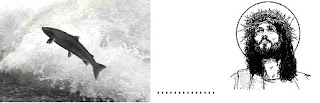

I rode into Christianity riding on the back of a salmon. It was the salmon’s life cycle that gave me a window into the Jesus story. It opened the door to the church. Here’s how it happened:
Many years ago I visited the fish ladder at the Ballard Locks here in Seattle to watch the salmon returning from the sea to their spawning grounds. They were eagerly going home to die for the sake of future generations. As I watched them struggling against the current, swimming upstream with great effort, I cried at the beauty of it. I learned that their dissolving corpses served as nourishment for the new life they had created just before they died. I made no connection to Jesus at the time as I was defiantly unchurched. Christianity wasn’t even on my radar.
About 10 years ago I cautiously approached the idea of institutional Christianity and took the sacramental bread and wine for the first time in maybe 30 years. I heard the stories about Jesus’ crucifixion and resurrection and remembered the salmon. Soon I came to understand those stories as representing the same process revealed in the salmon life cycle. Jesus sacrificed his life as all living things do so that others may live. But, by dying, we become immortal. It’s part of the nature of things. Dead flowers and leaves become humus out of which new life emerges. We eat Jesus’ body and drink his blood to symbolically nourish us as we journey through our lives toward union with God.
Concerned that my equating Jesus with salmon might be considered irreverent or even heretical, I did not speak of this until attending a retreat on Celtic Christianity where I learned that the salmon is a symbol for Jesus among the Celts. I now proclaim that as embodied beings, Nature is where we encounter God.
Many years ago I visited the fish ladder at the Ballard Locks here in Seattle to watch the salmon returning from the sea to their spawning grounds. They were eagerly going home to die for the sake of future generations. As I watched them struggling against the current, swimming upstream with great effort, I cried at the beauty of it. I learned that their dissolving corpses served as nourishment for the new life they had created just before they died. I made no connection to Jesus at the time as I was defiantly unchurched. Christianity wasn’t even on my radar.
About 10 years ago I cautiously approached the idea of institutional Christianity and took the sacramental bread and wine for the first time in maybe 30 years. I heard the stories about Jesus’ crucifixion and resurrection and remembered the salmon. Soon I came to understand those stories as representing the same process revealed in the salmon life cycle. Jesus sacrificed his life as all living things do so that others may live. But, by dying, we become immortal. It’s part of the nature of things. Dead flowers and leaves become humus out of which new life emerges. We eat Jesus’ body and drink his blood to symbolically nourish us as we journey through our lives toward union with God.
Concerned that my equating Jesus with salmon might be considered irreverent or even heretical, I did not speak of this until attending a retreat on Celtic Christianity where I learned that the salmon is a symbol for Jesus among the Celts. I now proclaim that as embodied beings, Nature is where we encounter God.
Nancy Finley is a long time member of St. Paul’s and is currently a graduate student at Seattle University’s School of Theology and Ministry studying to be a spiritual director. She also is on the faculty at North Seattle Community College and teaches lifespan developmental psychology online. Her course website is: here.
Thursday, March 20, 2008
Feet
By Alissa Newton
Today is Maundy Thursday , the beginning of the end of Lent and the beginning of the Triduum, the time when we remember and liturgically re-live the three days before the death of Christ.
I've always loved Maundy Thursday, even before I knew that some people used that name for it. Growing up in an evangelical non-liturgical tradition the Thursday before Easter was simply "The Foot-washing Service." There is something undeniably intimate and vulnerable about the washing of feet, and as a child I found this both moving and sort of thrilling. In the church of my childhood this was a segregated service, women in one room and men in the other. I don't know what happened for the men, but in the women's group we would all sit in a circle and sing hymns. Every year sometime before the foot-washing service my Mom would tell me a story about one of the first times she attended, when she was a young woman. She might have even been a teenager. After the singing of hymns began, each woman would wash the feet of the woman sitting next to her, and so on in a circle until everyone had both washed and been washed. My mother, the young woman, happened to be sitting next to one of the matriarchs of the church, an elderly lady whose movements were slow and hands shook. Mom was slightly horrified to realize that this woman would be washing her feet. I remember listening to my mother tell of how she sat and had her feet washed by someone so much older than her, wiser, and much more frail, and how that moment both humbled and exalted her. Sometimes when she told the story her eyes would brim with tears, remembering. I loved to hear it, and I loved to be a part of the whole ritual. The church I grew up in had little in the way of formal ritual, but what we had I reveled in. At the Foot-washing I felt connected to the Church, even as a child, in a way that was unique to my experiences in church at the time.
Now I still love the footwashing ritual. Set within an Anglo-Catholic mass, with choir and Eucharist, robes and incense, men and women together - the washing of another human being's feet remains one of the most intimate and powerful experiences of community that I have ever been exposed to. It is an act of service that is equally humbling for both recipient and the one who washes. Feet are so often a neglected body part - they do so much of the work of getting us around, but in our culture are seen as dirty and sort of private. It's rare to have someone else touch them. And even more so in the context of the Sacred. We Anglo-Catholics are so in love with Beauty and Mystery, two qualities rarely discovered in feet.
I hope today can be a reminder to me that in the context of Eucharist, in the Kingdom of God, the neglected and dirty can be part of what is Holy and Beloved and Beautiful. Jesus' feet were washed by the tears of a shamed woman who brought him perfume. Jesus washed his disciples feet before he gave them the first Eucharist. Humility and vulnerability are powerful and important, these stories tell us, and Christ proves to us as he embodies both in order to bring us through Maundy Thursday and tomorrow's Good Friday, to Easter.
Alissa Newton is Jr. Warden at St. Paul's and the editor of the parish blog. This entry is cross-posted to her personal blog, which can be found here.
Today is Maundy Thursday , the beginning of the end of Lent and the beginning of the Triduum, the time when we remember and liturgically re-live the three days before the death of Christ.
I've always loved Maundy Thursday, even before I knew that some people used that name for it. Growing up in an evangelical non-liturgical tradition the Thursday before Easter was simply "The Foot-washing Service." There is something undeniably intimate and vulnerable about the washing of feet, and as a child I found this both moving and sort of thrilling. In the church of my childhood this was a segregated service, women in one room and men in the other. I don't know what happened for the men, but in the women's group we would all sit in a circle and sing hymns. Every year sometime before the foot-washing service my Mom would tell me a story about one of the first times she attended, when she was a young woman. She might have even been a teenager. After the singing of hymns began, each woman would wash the feet of the woman sitting next to her, and so on in a circle until everyone had both washed and been washed. My mother, the young woman, happened to be sitting next to one of the matriarchs of the church, an elderly lady whose movements were slow and hands shook. Mom was slightly horrified to realize that this woman would be washing her feet. I remember listening to my mother tell of how she sat and had her feet washed by someone so much older than her, wiser, and much more frail, and how that moment both humbled and exalted her. Sometimes when she told the story her eyes would brim with tears, remembering. I loved to hear it, and I loved to be a part of the whole ritual. The church I grew up in had little in the way of formal ritual, but what we had I reveled in. At the Foot-washing I felt connected to the Church, even as a child, in a way that was unique to my experiences in church at the time.
Now I still love the footwashing ritual. Set within an Anglo-Catholic mass, with choir and Eucharist, robes and incense, men and women together - the washing of another human being's feet remains one of the most intimate and powerful experiences of community that I have ever been exposed to. It is an act of service that is equally humbling for both recipient and the one who washes. Feet are so often a neglected body part - they do so much of the work of getting us around, but in our culture are seen as dirty and sort of private. It's rare to have someone else touch them. And even more so in the context of the Sacred. We Anglo-Catholics are so in love with Beauty and Mystery, two qualities rarely discovered in feet.
I hope today can be a reminder to me that in the context of Eucharist, in the Kingdom of God, the neglected and dirty can be part of what is Holy and Beloved and Beautiful. Jesus' feet were washed by the tears of a shamed woman who brought him perfume. Jesus washed his disciples feet before he gave them the first Eucharist. Humility and vulnerability are powerful and important, these stories tell us, and Christ proves to us as he embodies both in order to bring us through Maundy Thursday and tomorrow's Good Friday, to Easter.
Alissa Newton is Jr. Warden at St. Paul's and the editor of the parish blog. This entry is cross-posted to her personal blog, which can be found here.
Friday, March 7, 2008
Later in Lent
by Stephen Crippen
Later in Lent
I’m out of breath. I’m panting, even.
I thought I was in better shape than this.
This isn’t a desert. It’s a forest wilderness.
I can hardly see everybody else.
I keep getting tangled up in branches,
branches with annoying little thorns, ivy, bramble.
I keep tripping on rocks and roots.
I think I hate that most of all.
No, I hate the heat and humidity down here.
My socks are around my ankles.
My pants are dragging and sagging.
I’m disheveled.
I feel like maybe I’m making progress,
but who knows.
They say forests need to burn every few years
to restore the ecosystem,
to keep the whole thing healthy.
I say, pass me a match.
It seems like other people are handling this better.
They seem to be walking more freely.
I console myself: I just can’t see some of their branches.
Maybe the others are also bound (and gagged?)
by their own
little demons.
(True confession: I hope so.)
They say we’re going to make a
”new fire”
that will be a festival of
dazzling light
luscious warmth
new life
everyone at the table
everyone pulling a piece of bread
from one warm, fragrant loaf.
I say, I hope I have sense enough
--when the fire is blazing—
to take off my shoes
and breath enough
to stammer out the word—
”Alle—“
I’m out of breath. I’m panting, even…
Stephen is a therapist and postulant to the Diaconate. You can find his personal blog on his website, here.
Later in Lent
I’m out of breath. I’m panting, even.
I thought I was in better shape than this.
This isn’t a desert. It’s a forest wilderness.
I can hardly see everybody else.
I keep getting tangled up in branches,
branches with annoying little thorns, ivy, bramble.
I keep tripping on rocks and roots.
I think I hate that most of all.
No, I hate the heat and humidity down here.
My socks are around my ankles.
My pants are dragging and sagging.
I’m disheveled.
I feel like maybe I’m making progress,
but who knows.
They say forests need to burn every few years
to restore the ecosystem,
to keep the whole thing healthy.
I say, pass me a match.
It seems like other people are handling this better.
They seem to be walking more freely.
I console myself: I just can’t see some of their branches.
Maybe the others are also bound (and gagged?)
by their own
little demons.
(True confession: I hope so.)
They say we’re going to make a
”new fire”
that will be a festival of
dazzling light
luscious warmth
new life
everyone at the table
everyone pulling a piece of bread
from one warm, fragrant loaf.
I say, I hope I have sense enough
--when the fire is blazing—
to take off my shoes
and breath enough
to stammer out the word—
”Alle—“
I’m out of breath. I’m panting, even…
Stephen is a therapist and postulant to the Diaconate. You can find his personal blog on his website, here.
Thursday, March 6, 2008
Humility
by Martha Wakenshaw
I've been thinking a lot lately about Christianity and Psychology, especially in this season of Lent.
The prayer book talks about penitence and even our own "wretchedness." It talks about confessing our sins and keeping a contrite heart. We fall to our knees in supplication. We ask God's forgiveness. We stand corrected.
So how does this season of penitence fit in with our own self-esteem? How do we bow down and confess our sins before God and still maintain a healthy sense of self-esteem?
I believe that God has given us humility as a way around this conundrum. Humility in the sense of softening our hearts to allow the light and compassion of Jesus in. With the spirit of God internalized we come from a place of strong vulnerability and are able to confess our sins in the all loving arms of Jesus, the great forgiver.
Martha Wakenshaw is a member of St. Paul's, a writer, and a psychotherapist. Her website can be found here.
I've been thinking a lot lately about Christianity and Psychology, especially in this season of Lent.
The prayer book talks about penitence and even our own "wretchedness." It talks about confessing our sins and keeping a contrite heart. We fall to our knees in supplication. We ask God's forgiveness. We stand corrected.
So how does this season of penitence fit in with our own self-esteem? How do we bow down and confess our sins before God and still maintain a healthy sense of self-esteem?
I believe that God has given us humility as a way around this conundrum. Humility in the sense of softening our hearts to allow the light and compassion of Jesus in. With the spirit of God internalized we come from a place of strong vulnerability and are able to confess our sins in the all loving arms of Jesus, the great forgiver.
Martha Wakenshaw is a member of St. Paul's, a writer, and a psychotherapist. Her website can be found here.
Subscribe to:
Posts (Atom)